
.webp)
Drone Training
Course Overview
This advanced course is designed for drone pilots who have already under gone basic drone pilot training and are familiar with drone rules,regulations, and flying techniques. Building upon their existing knowledgeand skills, participants will delve into specialized areas of aircraft inspectionusing drones, equipping them with the expertise required to conductadvanced inspections in various operational environments.
Course Objectives
Enhance proficiency in advanced flight maneuvers, specialized flightoperations, and payload integration for aircraft inspection missions.
Develop skills in data collection, processing, and analysis usingspecialized sensors and software tools.
Explore advanced applications of drone technology in aircraft inspection, including structural analysis, corrosion detection, and fatigue monitoring.
Apply theoretical knowledge and practical skills in simulated scenarios and real-world case studies to solve complex inspection challenges.
Aircraft Inspection Using Drones
Day 1
- Introduction to aviation industry and the importance of aircraft inspection.
- Regulatory bodies and standards governing aircraft inspection procedures.
- Basic of drone technology: types of drones, components, and capabilities.
- Overview of the role of drones in modern aviation and their applications in aircraft inspection.
Day 2
- Principles of flight planning for drone operations: airspace, weather, and terrain considerations.
- Introduction to NOTAMs (Notice to Airmen) and their relevance to flight planning.
- Risk assessment methodologies and mitigation strategies for safe drone operations.
- Emergency procedures and protocols for handling unexpected situations during drone flights.
Day 3
- Types of cameras and sensors used in drone-based inspection: RGB, thermal, multispectral, LiDAR.
- Camera settings and configurations for optimal data collection in different inspection scenarios.
- Techniques for capturing high-resolution imagery and video footage for detailed analysis.
- Data management and storage protocols for organizing and cataloging inspection data effectively.
Day 4 & 5
- Introduction to image processing software tools and their capabilities.
- Techniques for stitching aerial imagery to create orthomosaic maps and 3D models.
- Methods for analyzing drone-captured data to detect anomalies and defects in aircraft structures.
- Interpretation of inspection results and generation of comprehensive reports for stakeholders.
Day 6
- Exploration of advanced applications of drone technology in aircraft inspection: structural analysis, corrosion detection, and fatigue monitoring.
- Case studies and practical demonstrations of advanced inspection techniques in real-world scenarios.
- Group projects to develop and present innovative solutions for complex inspection challenges using drone technology.
Day 7
- Practical application of flight planning principles: route selection, altitude determination, and mission parameters.
- Hands-on experience with flight planning software tools: mission planner, airspace mapping, and route optimization.
- Field exercises in conducting pre-flight checks and setup of drones for data collection missions.
- Data collection techniques: capturing high-resolution imagery and video footage for inspection purposes.
Day 8
- Field exercises in conducting drone-based inspections on mock-up aircraft structures.
- Utilization of various sensors and cameras to capture inspection data in real-world scenarios.
- Hands-on experience with camera settings and configurations for optimal data collection.
- Practical application of risk assessment methodologies and safety protocols during field inspections.
Day 9 & 10
- Image processing workshops using industry-standard software tools: orthomosaic generation, 3D modeling, and point cloud processing.
- Techniques for analyzing drone-captured data to detect anomalies and defects in aircraft structures.
- Interpretation of inspection results and identification of critical findings for inclusion in inspection reports.
- Practical exercises in generating comprehensive inspection reports based on analyzed data.
- Final Test.
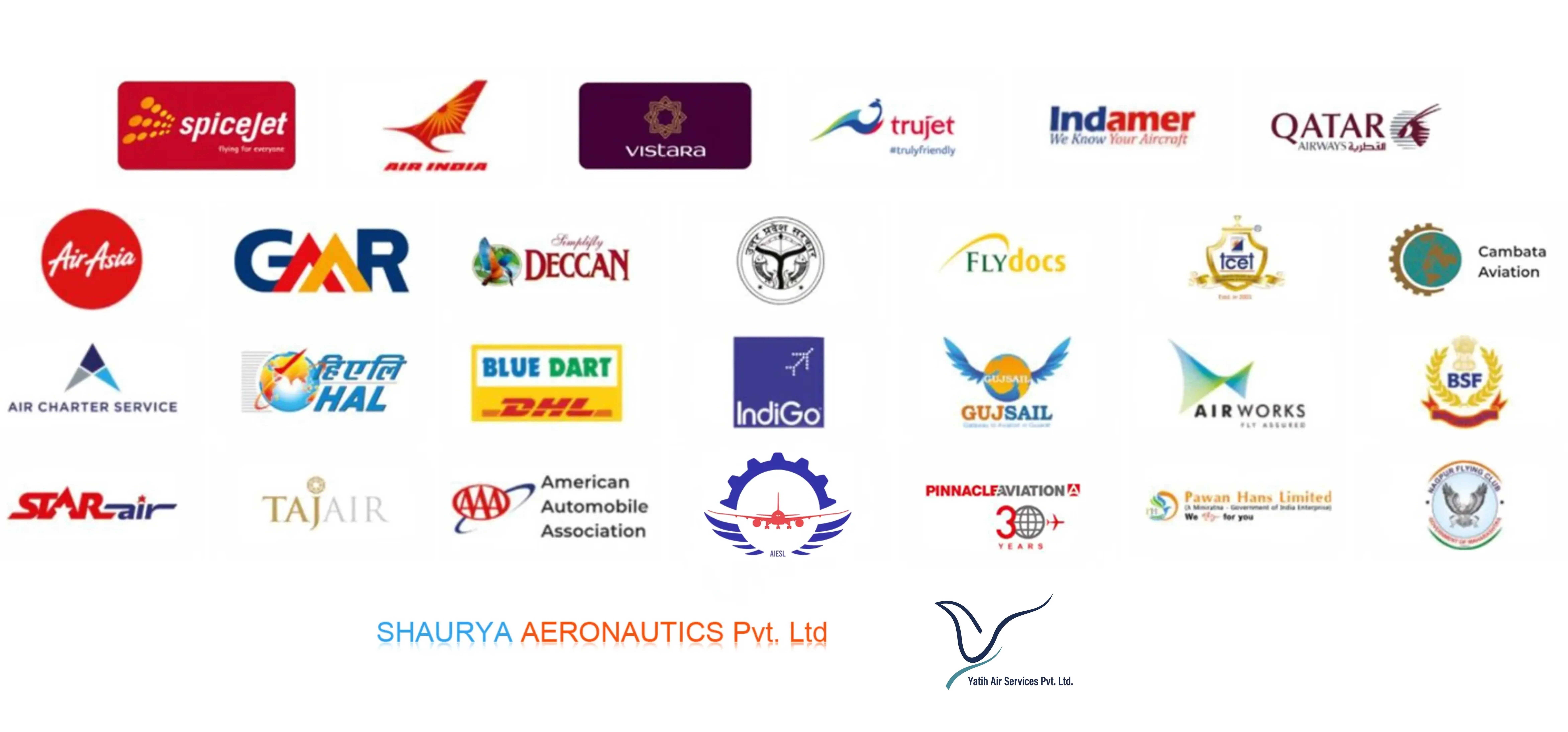
Some of the leading recruiters for Aircraft Maintenance Engineering:
Drone Training
Q: What is the focus of the WIIA Drone Training course?
A: It is an advanced 10-day training program specifically focused on "Aircraft Inspection Using Drones." It teaches pilots how to conduct complex inspections, structural analysis, corrosion detection, and aircraft fatigue monitoring.
Q: Who is eligible to enroll in this course?
A: This advanced course is tailored for existing drone pilots who have already completed basic drone pilot training and possess a solid foundation in drone flying techniques, aviation rules, and airspace regulations.
Q: What practical skills do participants develop?
A: Participants develop skills in advanced flight maneuvers, data collection using specialized sensors, 3D modeling, orthomosaic generation, analyzing drone-captured data to detect aircraft anomalies, and generating comprehensive inspection reports.
Q: How long is the advanced drone training program?
A: The program is structured over a 10-day duration combining theoretical instruction, flight planning, data collection field exercises, and image processing workshops.
Q: Which top airlines, MROs, and aviation organizations participate in campus recruitment and placement associations at WIIA?
A: The Western India Institute of Aeronautics (WIIA) maintains strong placement associations and recruitment pathways across major commercial airlines, leading Maintenance, Repair, and Overhaul (MRO) organizations, defense sectors, and government aviation bodies, including industry giants such as IndiGo, Vistara, Air India, Qatar Airways, AirAsia, Star Air, SpiceJet, TruJet, Jet Airways, GoAir, Kingfisher Airlines, TajAir, Air Charter Service, Pinnacle Aviation, and Simplifly Deccan. Furthermore, students secure exceptional career opportunities with technical partners and MRO leaders like Air Works, Indamer Aviation, Max Aerospace & Aviation Ltd, Flydocs, Blue Dart DHL, Cambata Aviation, MRO organizations, and Shaurya Aeronautics Pvt. Ltd. The institute's robust placement network also extends to prestigious public sectors, defense bodies, and aviation infrastructure groups, including Hindustan Aeronautics Limited (HAL), the Border Security Force (BSF), GUJSAIL, Pawan Hans Limited, the Government of Uttar Pradesh, GMR Group, Ahmedabad Aviation Academy, Nagpur Flying Club, Orient Flights, Thakur College of Engineering and Technology, and Pilot Communications USA, ensuring a highly comprehensive and successful aviation ecosystem for all graduates.
.jpg)